
Florida Bass
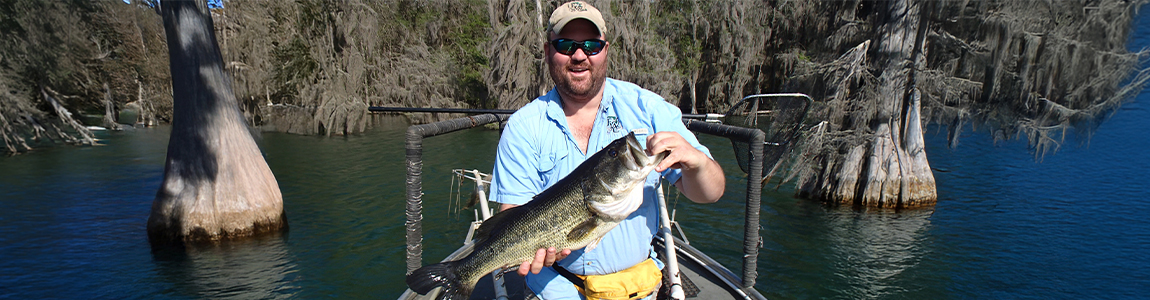
Check out this information on Florida's premier sport fish, the Florida Bass
Stocking of Hatchery-Reared Florida Bass in Lake Talquin (2022-2024)

Florida bass stocked into Lake Talquin 2022 - 2024
- Stocked 274,300 in May of 2022.
- Stocked 442,800 in May of 2023.
- Stocked 148,137 in May of 2024.
- This completes a 3-year effort to enhance Talquin's Florida bass population.
Lake Talquin (25 miles west of Tallahassee) is an 8,800-acre reservoir formed in the late 1920s by damming the Ochlockonee River. This productive reservoir has an abundant supply of shad (critical Florida bass prey). However, Lake Talquin is deeper than most Florida waters and does not support the extensive aquatic vegetation that is important to early bass survival and recruitment. As a result, most year classes of bass are marginal to poor except following extreme, habitat producing drawdowns of the reservoir. Florida bass usually do not spawn until late March or April in Lake Talquin, which is often too late to take advantage of the abundant shad produced in April and May. Shad spawned in the spring quickly outgrow young native bass because of slower bass growth.
To evaluate any stocking program, biologists must be able to identify hatchery fish. Researchers can do this through genetic parentage analysis, comparing tissues samples from Florida bass collected during their sampling efforts to the genetic make-up of the brood stock Florida bass used at the hatchery. In May 2022, approximately 274,300 (1.5 - 3 inches) Florida bass were stocked into Lake Talquin. By December of 2022, the stocked Florida bass made up an estimated 10% of the 2022 year-class. In May 2023, an additional 442,800 (1.5 - 3 inches) Florida bass were stocked into Lake Talquin. By December of 2023, those stocked Florida bass made up an estimated 12% of the 2023 year-class. These preliminary results over the first two years suggest far-less contribution to their respective year-classes than previous stockings in the early 2000’s. Hatchery contributions ranged from 17-40% of individual year-classes from 2000-2003. The final year (2024) of this 3-year stocking effort was aimed to produce and stock fewer bass, but of a larger-size (3 inches or greater) at the time of stocking in hopes of increased survival. In May of 2024, FWC stocked 148,137 Florida bass that averaged just over 3 inches in length. By November of 2024, the stocked Florida Bass made up an estimated 16% of the 2024 year-class.
In summary, FWC stocked more than 865,000 Florida bass into Lake Talquin from 2022 to 2024. Success of these efforts will be determined in years to come through electrofishing surveys and monitoring catches in Lake Talquin’s Florida bass tournaments. Researchers hope to replicate previous successes to help make Lake Talquin a premier destination for trophy bass in Florida once again.
TrophyCatch Research

Our biologists partner with our friends at the TrophyCatch program to provide research on Florida's trophy bass populations. Head this what to see what we've learned: TrophyCatch Research.
Interested in Genetics Research?
Head this way to check out Freshwater Fisheries Florida Bass genetic research.