
Genetics
Genetics Research

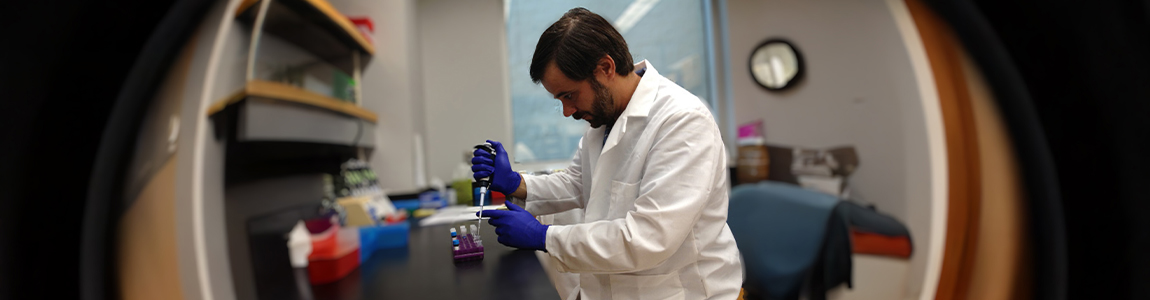
FWC biologists collaborated with researchers in the Texas A&M Marine Genomics Lab to develop an epigenetic clock for Florida Bass. Epigenetic clocks represent an emerging technology in fisheries science that allows biologists to accurately, precisely, and nonlethally estimate fish age from only a small bit of fin tissue and the DNA within it. The Florida Bass epigenetic clock was developed by identifying locations within the species’ genome that regularly accrue or lose methyl molecules (–CH3) throughout a bass’ lifespan. Essentially, these locations can be thought of as timers or stopwatches that regularly advance or count down through time.
The initial epigenetic clock was developed and tested with Florida Bass collected from lakes Harris, Okeechobee, Tarpon, Kinsley, Porter, and Rodman Reservoir. Soon, it will be further tested with another round of samples from more waterbodies across Florida. Currently, the Texas A&M Marine Genomics Lab is in the process of developing a panel for the Florida Bass clock. The panel essentially makes processing new samples quick and easy in the lab, allowing FWC biologists the opportunity to scale up their use of this new age estimation technique to meet the needs of managing and conserving Florida Bass across the state. Population assessments that previously required lethal dissections of Florida Bass to obtain otoliths for age estimation will soon hopefully become fully nonlethal. One of FWC biologists’ ultimate goals is to incorporate epigenetic age estimation into TrophyCatch. Anglers frequently ask how old their trophy bass may have been, and soon they may have the opportunity to know the answer with near absolute certainty.

The Florida Bass (Micropterus salmoides) has been the species at the center of the freshwater genetics research program at the Florida Fish and Wildlife Conservation Commission (FWC). Recognizing the profound ecological, economic, and sociological benefits that bass have for Florida, FWC has devoted resources to ensure that genetic research can contribute to the successful management and conservation of populations across the state. Staff at the FWRI headquarters in St. Petersburg Florida are routinely working on genetics projects focused on Florida Bass.
The genetics program has conducted several studies that have investigated the genetic relationships between Florida Bass inhabiting waterbodies in different parts of the state. Regional differences have been identified and used to develop rules for how and where fish can be moved within Florida. This will ensure that natural differences are conserved and fish that are adapted to their native environments are not replaced with non-native stocks.
All fish brought to the Florida Bass Conservation Center hatchery to be used as Florida Bass brood fish are genetically tested to ensure that they are not hybrids between Florida Bass and the closely related species Largemouth Bass (M. nigricans). These two species interbreed when they come into contact, which has the potential to lead to the introgression of native Florida Bass populations if Largemouth Bass are released into their waterbodies. Genetically testing all potential brood fish to ensure that they are Florida Bass before they spawn ensures that Largemouth Bass and hybrids will not be introduced to Florida Bass populations by FWC stocking programs.
Genetic techniques have also been used to identify fish produced from the hatchery after they have been captured in stocked waterbodies. Hatchery released fish can be genetically linked to their parents that spawned at the hatchery, allowing researchers to determine whether fish caught in a lake had been produced by hatchery spawning or not. Collecting this information allows managers to estimate the level of contribution the stocked fish have made to the wild population. They may use this information to determine whether an individual stocking meets management goals and predict how the stocking may impact the population going forward.
The genetics program will continue to work on these topics and any others where managers believe that genetic techniques can assist in the conservation and management of these important sportfish.