
Long Term Monitoring
Building Blocks and Findings from the Long-term Monitoring Program
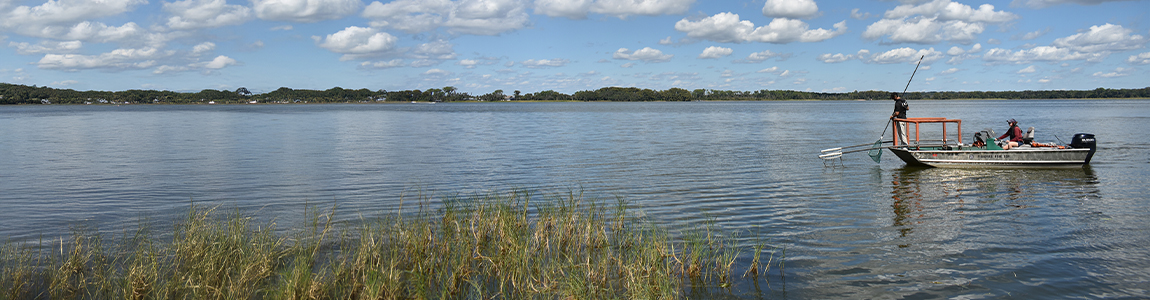
Biologists monitor long-term trends of Florida’s freshwater resources.

- The Freshwater Fisheries Long-Term Monitoring program began in 2006.
- Each year data is collected on the fish community, habitat, and sport fisheries of over 50 waterbodies.
- Fish are collected using electrofishing and trawls with notable health conditions documented.
- Aquatic plant surveys are conducted during summer months and the data are used to monitor changes in lake vegetation.
The Fish and Wildlife Research Institute (FWRI) Freshwater Fisheries Research section began the Long-Term Monitoring Program for Florida’s freshwater resources in 2006. What started as a focus on fish data for lakes has expanded to include river systems and aquatic habitat. Researchers’ primary objective is to track freshwater fisheries and habitat trends over time using standardized methods that help ensure the integrity of the data collected across the state. This information can then be used to assess the overall health of Florida freshwater resources, direct research efforts, and make management decisions.
Each year, biologists collect data on the fish community and sport fisheries of more than 50 lakes and rivers statewide. They add this information to a large database where it is available for use in future studies or evaluations conducted by researchers and fisheries managers. As of 2019, the database contained over 3 million records, and the number will continue to grow as the project continues.
Data Collection Methods
Biologists with FWRI, as well as other FWC divisions, use a variety of methods to sample freshwater fish communities. The type of equipment used depends on the target species, sampling location, and habitat. Researchers most commonly use two types of equipment to collect fish data in Florida’s lakes and rivers:
- Electrofishing is used to collect fish in shallow water, 2-6 feet deep. The most common species are Florida bass (Micropterus salmoides) and bluegill sunfish (Lepomis macrochirus), which have been collected in every lake sampled. This gear is also used to assess sport fish populations in the spring.
- Trawling is used to collect fish in open water during the fall. The trawl boat pulls a net suspended near the lake bottom as it moves forward. The net dimensions are configured to target young black crappie (Pomoxis nigromaculatus), and using this gear helps fisheries biologists assess populations of this popular sportfish.
In addition to length and weight measurements, fish collected during sampling events are also observed for abnormalities. Any notable health conditions, such as sores or lesions are recorded in order to monitor fish health trends.
Since the beginning of the Long-term Monitoring Program, water quality and details about the amount and types of plants present have been recorded with each fish sample.
However, in 2015, a formal aquatic vegetation monitoring program was put in place. During summer months, boats equipped with sonar mapping devices criss-cross each lake along evenly spaced transect lines. Biologists also collect plant samples at points along the transect lines using a plant rake. This information allows biologists to produce detailed plant maps for approximately 50 lakes each year.
Importance of Monitoring Data
Using the above methods, biologists monitor and measure the following fish metrics:
- Species diversity – an index of the number of species and abundance of each that make up a fish community
- Species richness – a component of species diversity that represents the number of different fish species present in the community
- Catch rate – an index used to estimate the relative abundance or density of fish, and can include values for all fish (total catch rate) or groups of fishes (e.g., catch rates of sport fishes or nonnative fishes)
The long-term monitoring project is another opportunity for scientists to monitor freshwater fish communities that are valuable resources to the state of Florida. State, federal and academic personnel use the data collected to develop management strategies and conduct related research as scientists produce a more complete picture of long-term trends. Additional information like water quality and plant data are used to help explain changes observed in the fish community or fishery.
Biologists use otiliths to determine the age of fish.

Age is one of the most important pieces of data researchers collect about both freshwater and saltwater fish. Biologists use bones in the inner ear of the fish called otoliths, or ear stones, to determine how old an individual fish is. These bones have rings very much like a tree trunk, and every year environmental triggers cause a new ring to form. Biologists remove the otoliths from the fish and count the rings. There are several things researchers can gather from this information.
Size at age: Size at age graphs are created by comparing a fish’s age to its length. This tells researchers how fast the fish are growing and at what age they become big enough to catch. The information from size at age can be used by management officials as part of the decision making process on length limits and to evaluate the quality of the food sources and habitat in a water body.
Year Classes: Researchers can also use age data to follow groups of fish born each year called, year classes. For example, biologists observed large year classes of bass following drawdowns on lakes Toho and Kissimmee. These fish went on to produce many trophy bass and biologists were able to document long-term improvements resulting from management practices.
Mortality: Biologists can estimate the rate that fish die from the number of individuals collected from each year class. This is used to predict how many fish will be available to anglers in future years.
Florida bass can reach 16 years old in Florida. After about 8 pounds, some say you can guess the age at about a year per pound. This is nothing more than a good guess though, as FWRI biologists have seen 10 pounders that range from just 4 to 14 years old. Black crappie can make it to 10 but rarely make it past 6 years old. The same goes for most of the bream, like bluegill and shellcracker.
Freshwater fisheries biologists calculate condition to observe the overall health of fishes.

Freshwater fisheries biologists with the Fish and Wildlife Research Institute (FWRI) have many tools to assess sport fish populations. They can count the number of fish they collect in a sample to learn how many fish are in the lake, and they can count the rings of ear bones (called otoliths), much like the rings of a tree, to learn how old the fish are and how fast they grew. What do biologists use to determine a fish’s overall health? Often the first step in assessing health is calculating something biologists call condition. Condition is measured using the length and weight of the fish. Biologist can compare these values with other fish to determine if it has relatively good or poor condition. Basically, condition tells a biologist if a fish is fat, skinny or average for its length. Differences in condition among sizes or ages of fish can provide important clues about what may be happening within the population. For example, if condition is good for smaller, younger fish, but goes down for larger, older fish, there may be a problem with the amount of larger prey items in the lake. Biologists can then direct their efforts to learning more about the food availability in the water and take actions such as stocking bait fish species to improve the fish population.
One of the most common factors for measuring condition is relative weight. To find a relative weight, scientists first come up with a standard weight based on averages from thousands of measurements of fish collected throughout their geographic range. They then divide the actual weight of a fish by the standard value found from the averages and multiply it by 100. Think of relative weight as a percent. A relative weight at or near 100 would be the normal weight for a fish of that length. Values over 100 indicate the fish is healthier than a typical fish of that size. A fish’s condition can change throughout the year, so this value should only be used as a general benchmark.
Biologists have used standard weight for decades, but these equations were primarily developed for popular sport fishes such as Florida bass or bluegill. More recently, biologists have started developing standard weight equations for other species, including rare and geographically limited species. For example, FWC researchers recently helped to develop a standard weight equation for the Suwannee Bass (Micropterus notius) which has one of the smallest distributions of black bass species, only occurring in a handful of rivers in Florida and Georgia. Calculating condition is quite simple and allows biologists and anglers alike to quickly assess the condition of fish in a lake.
If you would like to see a table of average weights for specific lengths of some of our most popular species visit our Condition Table.
FWRI biologists encounter many saltwater species along the St. Johns River.

- Snook, redfish and even tarpon to name a few, have been seen in lakes along the St. Johns.
- Diadromous fish move from saltwater to freshwater or vice-versa to mate and grow to maturity.
- Some fish move between the two for other reasons, like looking for food.
- Salinity, temperature and resources are all factors in marine fish occurrences in freshwater.
Though we tend to think of fish as being “saltwater” or “freshwater” there are fish that can handle both fresh- and salt-water. Some like salmon, American eels and American shad move from saltwater to freshwater or vice-versa to mate and grow to maturity. These fish are called “diadromous” and the movement is a normal and essential part of their breeding and life cycle. Others, like tarpon, snook, mullet and redfish tend to move between fresher and saltier waters based on other factors, usually food.
How can they do it?
Part of it has to do with the fish itself. Some fish species are “stenohaline” meaning they have a narrow range of salt tolerance. Goldfish, pompano, many sharks and pike are examples of stenohaline fish. Their bodies can only handle a small range of salinity in the surrounding waters. Freshwater stenohaline fish tend to regulate this by putting out a lot of dilute urine and by actively taking in ions through their gills to keeps the water in balance. This process is called “osmoregulation.” If they did not, they would absorb water and lose ions like sodium, potassium, and chloride. Stenohaline marine fish, on the other hand, produce small amounts of concentrated urine and shed ions through their gills. In another form of osmoregulation, marine fish can actually drink seawater. If marine fish didn’t, they’d lose water and become dehydrated.
Euryhaline fish have bodies that can adapt to a wider salinity range. They can produce concentrated or dilute urine, their gills can take in or excrete ions and they may or may not drink the surrounding water. It all depends on the water they’re in. The water itself also has something to do with it. Not all freshwater is really “fresh,” and the St. Johns River is no exception. When ocean waters receded and uncovered the central landmass that is now Florida some 10,000 years ago, residual seawater became trapped in pockets of what is now our aquifer. Florida’s springs tend to have more salt and minerals in their water than others. Because of this, the water in the springs, runs, lakes, and river tends to have more ions and salt than freshwaters in the panhandle or in a state like Georgia. Salt Springs off of Lake George is a great example of this with salinities as high as 4 parts per thousand. Silver Glen Springs has salinities as high as about 1 parts per thousand. This makes it easier for euryhaline marine fish to osmoregulate.
Another advantage to Florida’s “fresh” waters is that most of Florida’s water comes from limestone aquifers. As water percolates through the ground and into the aquifer it slowly dissolves the limestone. This in turn causes our water to contain ions of calcium and carbonate, which make up limestone. These ions can be used by fishes in place of the sodium and chloride ions found in saltwater, and allow fish to maintain an ionic balance that helps them keep functioning normally.
Other variables can also determine whether a marine fish can get into freshwater or not. Some fish have a narrow temperature range they can tolerate (stenothermal) while others have a wider range (eurythermal). Some stenothermal fishes, like snook, can’t take cold water so they need warm winters to allow them to move up the Florida coast all the way to Mayport, then they can swim upriver to as far as Blue Springs in Orange City. Redfish and tarpon, which have a wider range of temperatures they can tolerate, can migrate up and down the St. Johns River during most of the year, so normal winters don’t keep them out of the river and lakes. They can be more “year-round” visitors. In fact, these fishes may be more prevalent in the springs in the winter as the warmer spring water temperatures are easier on them.
Finally, there’s food. Like people, fish go where the food is good. This means that predatory fish can come up the river when food items like shrimp, menhaden and anchovies, or mullet run up the river. These prey items are usually coming upriver themselves for food as well. Once in the river the predators may or may not be feeding on the items they were following and could transition over to other forage. As most anglers will tell you, Florida’s waters have ample sources of food, so it’s not odd for saltwater fish, once they’ve made their way into freshwater, to stick around and snack on the abundant forage.

Electrofishing FAQ
Head this way to learn more about electrofishing and get your questions answered.
Simply ShockingHow To Extract Otoliths from a Bass
In this video, an FWC biologist demonstrates how to extract otoliths from a Florida bass. Otoliths, commonly known as "ear stones," are hard, calcium carbonate structures located directly behind the brain of bony fishes. Biologists use otoliths to determine how old an individual fish is.