
Crayfish
Black Creek Crayfish Research

Black Creek crayfish – State Threatened.
FWC's research and conservation efforts for a North Central Florida endemic, the Black Creek crayfish:
- Black Creek crayfish, endemic to the Lower St. Johns basin, is one of three state listed crayfishes in Florida.
- Introduction of White Tubercled crayfish into the Black Creek watershed from other parts of Florida has resulted in dramatic declines of native Black Creek crayfish,
- The FWC is currently researching the population status, habitat preference, and life history of the imperiled Black Creek crayfish.
- Additionally, FWC is monitoring the spread of White Tubercled crayfish in Black Creek and testing methods for removing and preventing further spread of this invasive population.

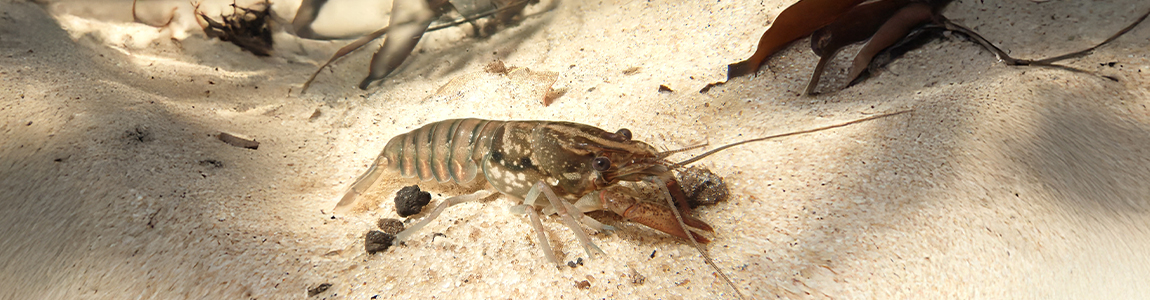
A Black Creek crayfish displaying its unique color pattern, featuring a dark carapace highlighted with white mottling, a light dorsal stripe, and red and black bands along the abdomen.
The Black Creek crayfish (Procambarus pictus) is one of only three state threatened crayfishes found in Florida and has been proposed for federal listing as an endangered species. This species is only found in the Lower St. Johns watershed in North Central Florida, primarily in the Black Creek watershed.
Black Creek crayfish is considered a habitat specialist compared with other species found in the Lower St. Johns basin, such as slough crayfish (P. fallax), peninsula crayfish (P. paeninsulanus), and Seminole crayfish (P. seminolae). The Black Creek crayfish inhabits cool, well-oxygenated, sand-bottomed streams with moderate to fast flow. In the daytime, they are usually found taking shelter in undercut banks or under submerged wood, vegetation, or detritus. At night, they can be found crawling in the open along the stream bed.

A white tubercled crayfish with characteristic white tubercles on the claws (mature individuals), legs with dark and light “candy cane” stripes (left), and two cervical spines on the side of the carapace (right).
Because this species is found within such a small range, human development affecting stream morphology or water quality within its habitat may pose a significant threat to its existence. Perhaps the greatest immediate threat to the Black Creek crayfish, however, is the spread of an invasive species – the white tubercled crayfish (P. spiculifer).
The white tubercled crayfish is native to parts of Florida, Georgia, Alabama, and South Carolina. In Florida, it is found in much of the panhandle, as well as the Suwannee, St. Marys, and Nassau river basins. In 2008, an introduced population of white tubercled crayfish was discovered in the Black Creek watershed of the Lower St. Johns River basin. By the early 2020s, this non-native population had spread throughout most of the Black Creek watershed, displacing Black Creek crayfish from much of its native habitat.
It is uncertain how the white tubercled crayfish was introduced or how it is displacing Black Creek crayfish. Crayfish introductions elsewhere have originated from the release of live unused bait and/or aquarium pets, as well as escapes from aquaculture. These introductions have resulted in displacement of native crayfish due to competition for shelter and food, predation, disease spread, and sometimes hybridization between native and introduced crayfishes.

Black Creek crayfish are only found within the Black Creek watershed (blue), which has been invaded by white tubercled crayfish, in addition to several smaller watersheds (yellow) in the Lower St. Johns basin (dark gray).
FWC’s Freshwater Research Institute (FWRI) and Habitat and Species Conservation Division (HSC) are working alongside several collaborating partners to research and protect Black Creek crayfish. Through extensive surveys of its historical habitat, researchers have identified a few isolated populations remaining in the Black Creek watershed. These are primarily found in uninvaded headwater reaches located upstream of physical or ecological obstacles to crayfish dispersal, such as waterfalls or lakes. Black Creek crayfish are also found in a handful of other small watersheds within the Lower St. Johns basin, which have not been invaded.
FWC is currently testing methods to protect remaining Black Creek crayfish populations from further displacement. Beginning in 2024, FWC and partners began using electrofishing efforts to capture and selectively remove invasive crayfish from streams that still contain native Black Creek crayfish.

FWC biologists use backpack electrofishing to dislodge crayfish from the streambank. Invasive crayfish collected with the dipnet are removed, and native species are released back to the stream.
FWC is currently testing methods to protect remaining Black Creek crayfish populations from further displacement. Beginning in 2024, FWC and partners began using electrofishing efforts to capture and selectively remove invasive crayfish from streams that still contain native Black Creek crayfish.
Eliminating or reducing the number of invasive crayfish in these reaches may allow native crayfish to persist for longer, but invasive populations further downstream will continue to re-colonize upstream unless action is taken to prevent their dispersal, such as implementing an in-stream exclusion barrier.
In 2025, an in-stream barrier was constructed on an experimental reach of Black Creek to prevent upstream dispersal of the invasive species, thus protecting the native species’ habitat in the upstream portion. Researchers assessed baseline stream characteristics of this reach, as well as existing fish and crayfish communities. These will be re-examined and periodically monitored post-installation to evaluate potential impacts of the barrier.
Ongoing research will also determine crayfish environmental preferences by comparing habitat occupied by Black Creek crayfish with habitat occupied by “generalist” crayfish species found within the same streams. Additionally, FWC biologists are researching life history attributes of Black Creek crayfish, such as reproductive timing. These studies will help inform future conservation efforts, such as habitat restoration and captive propagation.