
American Shad
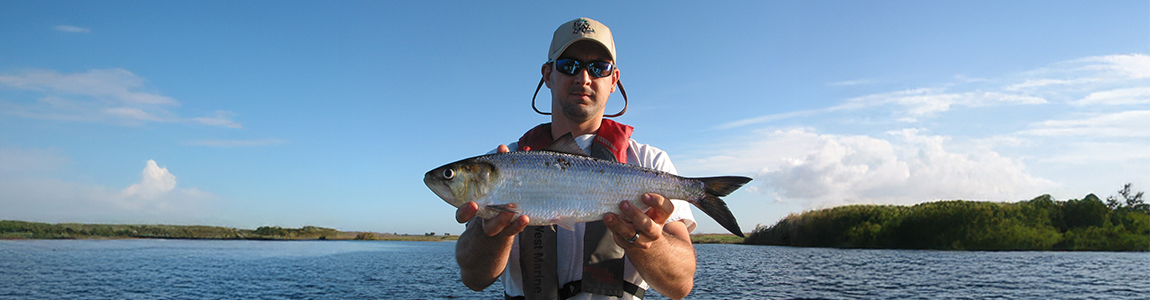
Although not usually thought of as a sport fish, American shad are still a popular catch amongst anglers.
FWRI's Freshwater Resource Assessment and Marine Fisheries Biology sections are assessing the current status of adult American shad in the St. Johns River.
Shad and Herring Research

American shad are a popular sport fish and are one of several herring species found in Florida. FWC’s Freshwater Fisheries Research section monitors the status of American shad in the St. Johns River.
American shad live in the ocean for three to seven years before returning to their home river to spawn. Spawning runs occur along the eastern coast of North America, from the St. Johns River in Florida to rivers in Canada. American shad once supported large
commercial fisheries in rivers along the U.S. East Coast. However, population declines have led to stricter regulations and fishery closures across much of the species’ range.
Commercial fishing for American shad in Florida declined through the 1980s and 1990s because of smaller runs, changing markets, and new regulations. A sport fishery still exists in the St. Johns River, and its popularity changes with the size of the annual run. Most American shad caught by anglers are released immediately, but regulations allow some fish to be kept by people who enjoy the roe and smoked meat.
FWC monitors run size, spawning success, fishing effort, and catch in the St. Johns River because American shad are ecologically and historically important to Florida. Monitoring also helps meet the requirements of a Sustainable Fishing and Management Plan overseen by the Atlantic States Marine Fisheries Commission.
Run size is monitored each year from January through March, and into April if the run continues that long. Primary sampling areas on the St. Johns River include Mud Lake near the Tosohatchee WMA to Lake Cone, Puzzle Lake to Lake Harney, and Lake Harney to Lake Monroe. During a sample day, biologists electrofish for a set amount of time at 10 randomly selected sites within a sampling area. All Alosa species collected are identified, measured, sexed, and released. Randomized sampling helps reduce bias and allows researchers to calculate catch per effort, which is used to track trends in population abundance over time.
Spawning success is measured by collecting juvenile fish downstream of spawning areas before they leave for the ocean. Sampling begins in March and usually continues through July or August, depending on catch rates. Sampling occurs on the St. Johns River between Blue Spring and Astor, and from Welaka to Palatka. Biologists use a push-net boat to collect 12 standardized samples from randomly selected sites along a 25-mile stretch of river during each sampling night. This survey provides an index of abundance that helps track trends in juvenile production over time.
Fishing effort and success are monitored by interviewing anglers at boat ramps during the fishing season. Information provided by anglers is used to estimate total fishing effort, the number of fish caught, and the number of fish harvested. These data help researchers identify changes in harvest patterns and determine whether fishing success is improving or declining.
Together, these surveys provide important information about American shad and the St. Johns River fishery. Researchers use the data to evaluate whether the population is increasing or decreasing, whether the timing and length of the season are changing, and whether river flow and water quality support successful spawning. The information also helps determine whether harvest trends remain consistent with population trends and if fishing regulations may need to be adjusted.
Shad FAQ
Several kinds of shad live in Florida. Gizzard shad and threadfin shad are members of the genus Dorosoma and are statewide, year-round residents of fresh and brackish waters. These are common prey items for predatory fish in many Florida lakes and rivers. American shad, hickory shad, and blueback herring-all members of the genus Alosa-live in the Atlantic Ocean and enter the St. John's and St. Mary's rivers in northeast Florida in winter and spring to spawn. Alabama shad and skipjack herring, also members of the genus Alosa, occur in gulf coast rivers; skipjack herring are limited to the panhandle, and Alabama shad occur as far east as the Suwannee River.
The American shad is the largest member of the herring family, Clupeidae. Most herrings are marine fish that dwell in the open ocean and feed on various type of plankton. American shad belong to the genus, Alosa, which includes anadromous members of the herring family. Anadromous fish live and grow in the ocean and swim upriver to spawn in fresh water. The shad that spawn in Florida's St. John's River generally live in the ocean for four years before returning to fresh water to spawn. American shad in Florida die after spawning.
Florida's shad are the smallest on the East Coast of the United States. In Florida, shad average 2 to 3 pounds; the state record is 5.19 pounds. In northern states, where they survive spawning and live longer, shad weighing 4 to 6 pounds are common, and state record fish exceed 10 pounds!
Many anglers think of gizzard shad, or "stink shad," when shad are mentioned in northeast Florida. Gizzard shad is the fresh-and-brackish-water dwelling cousin to the American shad. Gizzard shad are not good to eat and are very hard to catch by hook and line. American shad, on the other hand, do bite hooks when properly provoked, and they are feisty and fun to catch on light tackle. American shad were once considered a food fish, and some people still enjoy eating them. The flesh and roe (eggs) are both edible. In fact the scientific name for American shad, sapidissima, means "most savory." The flesh is delicate and sweet, but it is full of bones-making this fish a chore to eat. As a result, most shad captured in Florida are caught only for sport and released.