
Sailfin Catfish
Sailfin Catfish Research
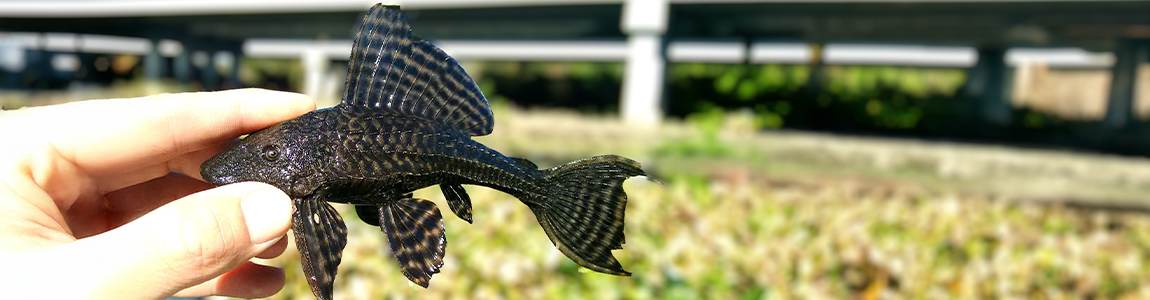
Sailfin Catfish are part of the family Loricariidae. There are three species of sailfin catfish found in Florida, vermiculated sailfin catfish, Orinoco sailfin catfish, and the Amazon sailfin catfish. They are native to South American and were likely introduced in Florida through people dumping their unwanted aquarium fish. They seem to do well in all types of Florida freshwater waterbodies including lakes, rivers, canals, springs, etc. Sailfin catfish are currently found across most of peninsular Florida from the Everglades up to the Gainesville area.
Sailfin catfish are typically found along the shoreline and in shallow areas of waterbodies. They are cavern spawners, creating burrows along shorelines to spawn in. They have also been found to burrow along or behind sea walls, water control structures, etc. There is concern that in some areas their burrows could undermine banks, shorelines, and even the structural integrity of some water control structures. When found in high densities this burrowing behavior could also lead to sedimentation issues impacting water clarity.
Currently, there is little research specifically looking at sailfin catfish. As of October, 2025 15,318 sailfins have been collected during regular FWC fish sampling events. These fish have been collected from 122 different waterbodies. There is currently an ongoing haul seine project on the upper St. Johns River to remove tilapia and this effort has also removed over 20,000lbs of sailfin catfish thus far. A previous telemetry study looked at movements of sailfin catfish in Silver Glen and Salt Springs off of Lake George. A high percentage of tag loss occurred on fish that were part of the study so movement data was only collected from a few fish. Those fish did not move much and did not leave the spring runs they were collected and tagged in.

In February 2021, acoustic tags were placed in 15 Blue Tilapia and 15 Sailfin Catfish at Salt Springs and Silver Glen Springs, for a total of 60 tagged fish. Fish were collected using boat electrofishing, large mesh gill nets deployed as seines, and by snorkelers who hand-grabbed Sailfin Catfish. Following tag attachment, all tagged fish appeared uninjured and were able to successfully swim away. However, Sailfin Catfish exhibited a low tag retention rate of approximately 20%, regardless of the tagging technique used. During the study period, bowfishermen harvested five tilapia (14%) and ten Sailfin Catfish (33%). Additionally, two shed acoustic tags were recovered by snorkelers, and five were turned in by bowfishermen. These recovered tags were redeployed in April 2021 on seven additional tilapia in Silver Glen, as Sailfin Catfish could not be effectively tagged.
Due to the high rate of tag loss, movement data for Sailfin Catfish were deemed unreliable. Nevertheless, the small sample size of active fish suggested that Sailfin Catfish do not migrate between springs and instead remain within spring runs and nearby Lake George habitats. In contrast, movement data for tilapia indicated that some individuals exhibited high rates of movement between springs, although few were documented leaving the Lake George system entirely. Furthermore, tag detections recorded by receivers in Juniper Run and the Silver Glen headspring demonstrated almost exclusive nocturnal activity, with 92% of total detections at both locations occurring between sunset and sunrise.