
American Eel
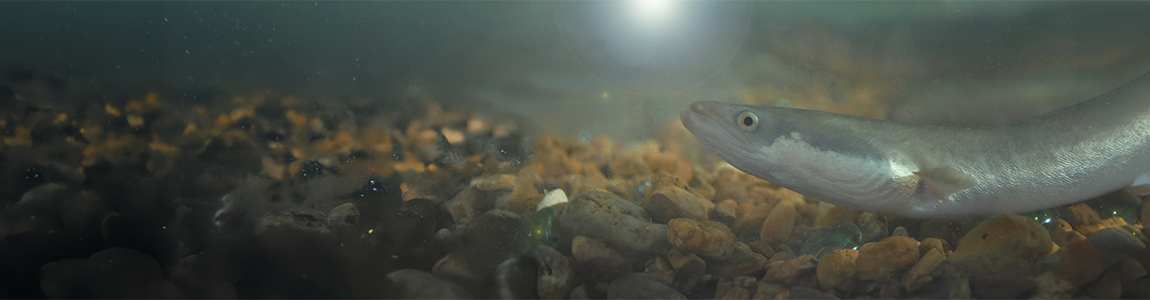
American Eel Research
FWC is mandated by the Atlantic States Marine Fisheries Commission to monitor young-of-year and adult yellow eels in Florida. Since 2001, data have been collected for eels that inhabit northeast Florida waterways.

Recent reports have raised concerns over the status of the American eel stock and have urged increased protection. Observed declines in the abundance and recruitment of this stock may be due to overfishing, habitat degradation, chemical contamination, and/or oceanographic changes. An exotic swim bladder nematode, Anguillicola crassus, has infected some U.S. populations; this parasite may affect eel behavior and even cause death. Other factors in the decline may include mortality due to turbine operations of hydroelectric dams and the harvest of sargassum weed from its breeding habitat. Due to its complex life history, it is extremely difficult to determine cause and effect between these factors and the observed declines. Furthermore, because it is a panmictic spawner (meaning all individuals are considered one interbreeding stock), populations throughout its entire range must be monitored simultaneously using similar methods to determine what factors are most important and how best to protect the species.
In 1999, the ASMFC developed a Fishery Management Plan for American eel, which is an interstate cooperative effort to protect and enhance the Atlantic stock of American eel in the United States while providing for a sustainable harvest of the species. A total of 15 Atlantic coast states are involved in this effort. Each of these state agencies is mandated to collect both specific fishery-independent and -dependent data. As part of this requirement, FWC and University of Florida personnel conduct routine monitoring of young-of-year (also known as glass) eels at Guana River Dam (St. Johns County) and juvenile eels at Rodman Reservoir or Kirkpatrick Dam (Putnam County), from January to March. Over an eight-week period in January and February, dip-net sweeps are made twice every half-hour during flood tide at the Guana River Dam site on four randomly selected nights each week. During February and March, lift nets are used to sample juvenile eels twice per week at Rodman Reservoir Dam during randomly selected periods at night. In addition to obtaining catch data, the eels' length, weight, and pigmentation stage are recorded. These data have been collected since 2001 and, along with data from the other participating states, were used in the 2005 coast-wide stock assessment. Environmental parameters, such as conductivity, flow, and moon phase, are also recorded to determine what factors may be driving the inland migration and movement of this species.
FWRI researchers are studying the prevalence of nematodes in the swim bladders of American eels.

Biologists with the Florida Fish and Wildlife Research Institute (FWRI) are studying an exotic nematode parasite found in American eels (Anguilla rostrata). Little is known about the prevalence of infection in Florida’s eel populations and researchers are trying to collect information on these eels in several freshwater systems to determine the prevalence and intensity of infection on a statewide level.
Researchers believe the nematodes have originated from Southeast Asia and are specific to eels of the genus Anguilla. Since first confirmed in South Carolina in 1995, the parasite Anguillicoloides crassus has been documented in American eels inhabiting many Atlantic coastal streams, from Canada south to Texas.
American eels become infected by consuming intermediate crustacean hosts, like copepods or ostracods. They can also become infected by eating a host that is unaffected by the parasite and is merely a carrier. Nematode larvae can remain inactive, although still infectious, in many organisms such as snails, amphibians, insect larvae, and some fish. Once ingested, the larvae migrate to the swim bladder where they mature, reproduce, and ultimately release eggs and larvae back into the water through the eel’s digestive tract.
The swim bladder is important for a fish to regulate its position in the water column. As a result, these nematode infections can influence the fish’s ability to move up and down in the water column and may affect the migration of mature eels to their spawning ground deep in the Sargasso Sea. Although eels appear to handle these chronic parasitic infections well, they may still have to expend a lot of energy to cope, making the fish more prone to disease or succumbing more easily to environmental stressors.
Previous studies have shown that physical barriers, such as dams, and cooler water temperatures can limit the level of infection in eels. Given Florida’s subtropical temperatures and limited number of physical barriers, scientists are concerned that these infections can be more widespread in these populations. Researchers also hypothesize that more urban areas have higher rates of infection due to increased stressors in the environment. In 2006, preliminary surveys of commercially harvested eels found as many as one third of eels from the St. Johns River were infected. Researchers are currently conducting dissections and assessing overall health of eels in freshwater systems to learn more about the potential effects this parasite may have on Florida’s American eel populations.
Biologists differentiate two eel species while sampling.

- FWC biologists oversee springtime American eel sampling.
- Young-of-year American eels have been collected every year since 2001
- Data collected provide information about the number of eels entering rivers along the U.S Atlantic Coast.
- In 2012, the Atlantic States Marine Fisheries Commission declared the American eel stock to be in a state of decline.
- Young speckled worm eels are very similar to young American eels.
- Many were misidentified during the first few years of sampling.
- Biologists were able to correct the data after finding speckled worm eels weigh much less.
Florida Fish and Wildlife Conservation Commission (FWC) researchers oversee the monitoring of American eels in early spring each year at Guana River Dam, located in South Ponte Vedra Beach, Florida. Sampling is done during night-time incoming tides using dip nets. Every year since 2001, as part of the Atlantic State Marine Fisheries Commission’s American Eel Fishery Management Plan, researchers have collected data about the number, size and pigmentation of young-of-year American eels. These data provide important information about their inland migration and the number of young eels entering river systems along the Atlantic Coast of the United States.
The two species featured in the pictures are the speckled worm eel (Myrophis punctatus; top) and American eel (Anguilla rostrata; bottom). They both have a similar life history, starting their lives offshore as larvae and then transforming into clear, miniature versions of their older selves, commonly called the glass-eel stage. American eels make this transition before they enter the estuary, but speckled worm eels primarily start transitioning after.
At this stage, speckled worm eel and American eel are hard to distinguish with the unaided eye. They are small, ranging from 1.5 to 2.5 inches long, and have a nearly clear, or “glass”, appearance. It is not surprising that glass speckled worm eel were misidentified as glass American eel in samples collected at Guana River Dam, Florida, from 2001 to 2005. It was not until 2006, when a large proportion of glass speckled worm eel appeared in samples, that researchers realized that more than one species of eel might be present.
Although their lengths are similar, glass speckled worm eel weighed much less and had distinctive physical characteristics that could be used for identification. After these discoveries, biologists sifted through archived samples, identified the two species and corrected the data. Glass speckled worm eel catches vary from year to year and researchers found no detectable pattern in timing or abundance of these eels. In 2006 and 2012, which had the two largest catches of glass speckled worm eel, biologists also could not detect a relationship between daily catch rate and measured environmental variables.
In 2012, the Atlantic States Marine Fisheries Commission declared the American eel stock to be in a state of decline. Measures have been taken to reduce the harvest of all life stages, included the glass-eel stage, in all Atlantic coastal states. In fall 2014, the State of Florida enacted a nine inch (229-mm) minimum length limit for harvested American eel, eliminating any chance of glass eel harvest. This leaves only South Carolina and Maine as Atlantic states where glass American eel harvest is allowed. It is important that biologists in Florida and other southeastern states who conduct young-of-year eel surveys in estuarine waters where these two species can coexist ensure proper identification of each species.
More information about the comparison between glass speckled worm eel and glass American eel can be found in the recently published article of Fisheries Management and Ecology.
Do you have questions about American eel? Read the American eel FAQ for answers.
The American eel is not federally listed as an endangered or threatened species under the U.S. Endangered Species Act (ESA) of 1973. In December 2004, the U.S. Fish and Wildlife Service and the National Marine Fisheries Service announced their intention to consider extending ESA protection to the American eel based on available biological data. The two agencies conducted a status review for the species, which included collecting and reviewing data from various state and federal natural resource agencies, tribes, and other applicable groups. Based on this information, they found that the species' overall population is not in danger of extinction. As a result, ESA protection is not warranted.
American eels are found over a large latitudinal gradient in the western Atlantic Ocean, and associated rivers and estuaries, from Greenland to the northern reaches of South America. In Florida, they can be found throughout most of the state in both fresh and brackish waters and in Atlantic and Gulf of America drainages.
American eels are considered to be catadromous, which means they live in freshwater and go to the sea to spawn. They spawn in the Sargasso Sea but spend most of their lives in estuarine or riverine systems where they grow and mature. Because they spend most of their lives in fresh or brackish waters, they are generally considered a freshwater species.
No one has seen an American eel actively spawning, but it is assumed that this occurs in the Sargasso Sea around January of each year. Thus, young eels (known as glass eels due to their lack of pigment) generally begin their migration into fresh water when they are between 9 and 12 months old.
American eels are opportunistic feeders, meaning they will eat any food available to them. They are considered carnivorous, with a diet including fish, frogs, insects and dead organisms.
There have not been many studies conducted on this species in Florida. The few studies on American eels in Florida's inland systems have primarily focused on artesian spring populations such as those found at Vortex Blue Springs (Holmes County) and Peacock Springs (Suwannee County).
There is a small commercial fishery for American eels in Florida, which operates almost exclusively in the St. Johns River system. Annual landings of American eels have been reported since the early 1980s, and commercial eel harvest has been declining since the early 1990s.
Reported landings of American eels in the United States have historically been concentrated in the central Atlantic states, from New Jersey to North Carolina (80%), with only about 1% of landings reported for southern states.
All commercial harvesters are required to have a valid freshwater commercial fishing license and obtain a no-cost permit from the Florida Fish and Wildlife Conservation Commission (FWC).